The preservation of cultural artefacts has shifted from rudimentary shelving toward adaptable, engineered frameworks. As museum collections grow annually, repositories face intense pressure to house incoming acquisitions within tight real estate boundaries.
Managing these dense collections requires effective space management and reliable storage. This is critical in high-density Asian megacities where land premiums are high, and institutions must protect diverse heritage assets.
Storage infrastructure must maximise vertical volume while safeguarding sensitive collections—ranging from delicate imperial silk textiles and porcelain to massive temple stone carvings—against the region’s challenging tropical humidity, monsoons, and ambient dust.
Structural and Preservation Bottlenecks in Deep Storage
Infrastructure Outpaced by Acquisition Rates
Collections grow faster than museum storage infrastructure, creating substantial operational logjams when new accessions arrive. When institutions depend on traditional, static shelving configurations, they quickly suffer from insufficient storage capacity. Furthermore, standard museum archival storage systems lack flexibility; their rigid parameters fail to adapt to irregular, heavy, or non-standard cultural materials.
Environmental Sensitivities and Regulatory Compliance
In high-density urban areas, maintaining stable, long-term preservation conditions is a complex technical challenge. The physical condition of fragile materials is not guaranteed when objects are housed on reactive surfaces that are prone to chemical off-gassing. Additionally, under-engineered configurations make it difficult to meet strict collection care frameworks and conservation standards, potentially causing institutions to fail formal regulatory and preservation audits.
Elevated Threat Exposure
Traditional storage layouts rarely integrate comprehensive disaster and risk mitigation protocols. When large artefacts or delicate scientific specimens are stored without appropriate structural retention features, the risk of damage from external vibrations, seasonal climate variations, or physical impacts increases significantly.
How Dexion Engineers Scalable Solutions for Museum Collections Management
We design specialised systems tailored to balance daily administrative accessibility with robust conservation safeguards. Our methodology addresses the core requirements of museum collections management by focusing on material inertness, structural modularity, and maximised footprint density.
Integrated Housing for Multidimensional Holdings
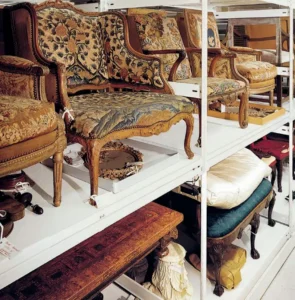
Our platforms offer unified collection housing for diverse objects within a single coordinated space. We create heavy-duty, customised frameworks that safely support paintings, textiles, sculptures, historical weapons, and heavy furniture pieces simultaneously.
High-Density Footprint Compression
By deploying high-density mobile shelving platforms, we compress the storage footprint by removing redundant access pathways. This approach maximises physical floor space while retaining immediate, safe access for curators and research teams.
Modular Adaptability
We prioritise structural versatility, ensuring that storage systems feature flexible, customisable, and modular storage options. This allows institutions to alter spacing, adjust shelf levels, or expand structural bays as seasonal accessions alter the repository’s inventory profile.
Preservation-Grade Micro-Environments
To protect fragile materials in museum archival storage, all our components use stable, chemically inert finishes. This approach prevents off-gassing and ensures micro-environments remain neutral. Additionally, our designs incorporate mechanical assists and safety lock mechanisms that provide operator safety and convenience for museum personnel, wrapped in clean, minimalist aesthetic options that suit commercial spaces and visible open-study vaults alike.
Specialised Systems for Scalable Collections Storage
Mobile Art Racks
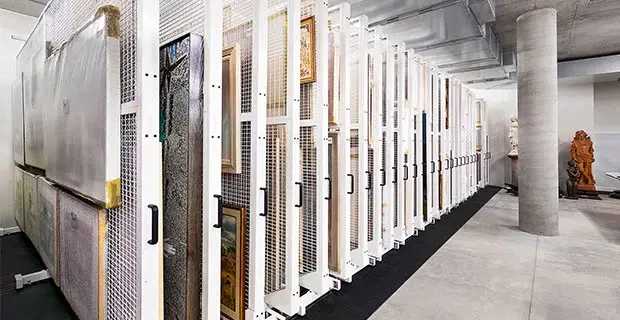
To optimise vertical hanging areas, these screens feature double-sided mesh flush to the art rack frame. Moving laterally on smooth guide tracks, they require only one access aisle and can store almost double the amount of material as conventional pull-out art racks. Constructed from durable steel, they accommodate nested and non-nested carriages to eliminate structural vibration.
Textile Racks and Drawers
To prevent the creasing of rare fabrics, we supply cantilever racks and rolled textile drawers. These specialised systems store long items from 60cm up to 6m in length on cantilever racking. All components feature a non-reactive, solvent-free, baked powder-coat finish to eliminate chemical transfer, and can be custom-designed and built to suit exact textile lengths.
Weapons Racks
These assemblies are engineered to be highly structurally sound for the long-term storage of heavy historical war weapons, ensuring easy retrieval for study or curation. Capable of integrating into new or existing shelving arrays, they feature adjustable barrel rests and optional bungee cords to prevent accidental dislodging, making them ideal for military weapons, rifles, and pistols.
Specialist Cabinets
Built from heavy-duty steel, these protective enclosures provide a resilient barrier against dust and light. They utilise a non-reactive, solvent-free, baked powder-coat finish combined with flush locking hardware and a three-point latch system, making them ideal for historical artefact storage, archival material, and delicate fossils.
Flat File Cabinets
Fitted with reinforcement channels spot-welded underneath to prevent deflection under heavy-weight loads, these multi-drawer units ensure long-term preservation and durability. They are specifically engineered for the flat storage of works on paper, architectural drawings, unframed photographs, and historical maps.
Specialised Compactus®
Available with manual, mechanical, or powered navigation adjustments, these high-density mobile carriages are built to carry Ultima Longspan or Ultima CI-80 shelving arrays. Heavy-duty and custom-designed, they ensure vibration-free travel that is ideal for artefact storage, fossils, and scientific specimens.
Oversized Compactus®
Designed for large and unique collections, these high-capacity mobile platforms are available in powered and mechanical designs. The heavy-duty structural bases facilitate the direct mounting of heavy pallet racking or cantilever racking onto the mobile frames, making them ideal for housing canoes, large fossils, dinosaur skeletons, and heavy stone statues.
Shelving Units
Designed with flexibility in mind, shelving options like Ultima Longspan and Ultima CI-80 multi-tier layouts can be configured in a variety of dimensions to hold delicate artwork, historical specimens, and ancient artefacts. Because the shelf heights are incredibly easy to adjust, they offer reliable configurations for everything from small, lightweight objects up to dense, heavy assets.
Conclusion
To protect cultural assets from overcrowding, institutions must regularly assess their current collection growth rate and work toward future-proofing their facilities. Investing in scalable museum archival storage infrastructure protects your holdings from accidental degradation and operational friction. Contact us today to request a professional collections storage assessment tailored to your facility.
Alternatively, browse the informative brochure for Dexion’s Collections range.